

There is a truth that every agency learns sooner or later, unfortunately most often the hard way: not every inquiry is an opportunity.
Some clients bring revenue on paper but take away profit in reality. They haggle over every hour, change the scope of work on the fly, pay late, and ultimately leave a bad review (or give a poor rating) because they didn’t get what they imagined—even though in reality they couldn’t explain what they imagined themselves.
This text is not a call to be selective on a whim; it’s about pure economics. The real cost created by the “wrong” client is almost never on the final invoice—it’s hidden in overtime hours, unpaid work, missed better opportunities, and a team that’s burning out.
The good news is that almost every problematic client sends a signal in the very first conversation. You just need to know how to read it.
Why This Is an Economic, Not Emotional, Question
Before we elaborate on the “signs,” here are a few figures that put things in perspective (without any dramatization—these are actual averages from documented research).
According to PMI‘s Pulse of the Profession report, 52% of projects experience so-called scope creep—the silent expansion of scope beyond what was agreed, with an increase of 43% over five years.
The average budget overrun on such projects is around 27%.
And that wouldn’t be so bad if these figures weren’t followed by this continuation: according to agency surveys, only about 1% of agencies charge for all the work done outside the agreement, and 57% lose approximately €900 to €4,300 per month on unpaid work.
And as if all that weren’t bad enough, this is often compounded by the problem of timely payment as agreed. Research by Intuit QuickBooks shows that 56% of small businesses have unpaid invoices at any given time, averaging around €15,000 per company, while Atradius reports for Europe that approximately half of B2B invoices are paid late.
For a small agency, this isn’t statistics—it’s salary, rent, and the budget for the next quarter.

Figure 1: Key industry data explaining the cost of a bad client
These are, of course, global averages based on available data. It will be extremely interesting to see the data and statistics in a year or so, now that the use of e-invoices is soon to be mandatory for everyone here, where every payment delay or non-payment can be seen quite precisely.
And Now the Most Interesting Part: Red Flags Visible Already in Negotiations
Most of these signs appear before you sign anything. If you recognize two or more, it doesn’t necessarily mean you should refuse the collaboration, but it certainly means you should slow down, set clearer boundaries, and put everything in writing.
- Guarantee of the impossible: A client who, at the very first meeting, asks you to “guarantee first place on Google,” a fixed number of inquiries per month, or “to go viral” does not understand how what they’re buying works. A serious partner talks about projections, testing, and risk.
- Haggling from minute one: When the first question is about price or a discount, when they compare your offer with someone who does something completely different (and the “client” doesn’t distinguish between them), and when they ask for a detailed breakdown of hours before you’ve even defined the scope of work—you’ve probably got a client who treats you as a cost, not an investment. Such clients train you to compete on price instead of value.
- “Just this one small thing”: A client who, already during the proposal, throws in “while we’re at it” and “that’s probably a small thing” is announcing future scope creep. Such “small things” add up, but that sum is never charged on the final invoice.
- Ghosting during negotiations: Late to calls without apology, doesn’t send materials for days, and then asks for something to be done “urgently by tomorrow.” There’s a well-known saying (slightly refined for this occasion): “How they behave during courtship is how they’ll behave in marriage.”
Poor communication before the contract is the best predictor of communication after it. - Graveyard of previous collaborators: If in the first conversation you only hear how the previous agency was a disaster, the previous designer incompetent, and the previous copywriter lazy—there’s a good chance the common denominator of all those stories is the client themselves. In a few years, you’ll be “that terrible agency” in their next story at some other agency.
- Avoiding the budget topic: A client who won’t give an approximate range, who becomes suspicious as soon as you mention payment terms, or who asks to start work before signing a contract is sending a clear financial signal. Often behind this lies either a non-existent budget or deeper organizational chaos.
- Micromanager: Each of us has encountered such people at least once, either privately or at work. When this happens in private spheres, it’s simple to tell someone to calm down and stop being a control freak. However, in business, it becomes a completely different story.
Such a person demands daily reports for weekly work, wants to approve every post and every line of text, but supposedly hired you for your expertise. This isn’t a partnership; it’s an expensively paid employee without an employment contract.
Special Case: The Client Who Doesn’t Understand What They’re Buying
This is a marker that deserves its own section in this text because it’s the most common and often well hidden behind nodding, skipping answers as if everything is clear, and similar communication methods of someone who fundamentally doesn’t understand the topic but knows they need to do something about it.
It’s not about malicious intent but about misunderstanding—and misunderstanding creates unrealistic expectations, and unrealistic expectations create dissatisfaction regardless of the quality of your work.
Typical signs that should immediately trigger additional caution:
- Confuses reach with sales: “We had 50,000 views, where are the orders?“—doesn’t understand the difference between the top and bottom of the sales funnel*.
- Expects SEO results “in two weeks” and a website that’s “built once and done,” instead of understanding it as a living tool that requires maintenance.
- Doesn’t distinguish strategy from execution: Pays for posts but expects sales growth; pays for an ad but expects brand building.
- Measures the wrong things: Obsessed with likes and followers (“vanity” metrics) rather than inquiries, cost per acquisition, or return on investment.
- Can’t define success: When asked “What would a successful project look like for you in six months?” has no concrete answer except “for it to be better.”
Such a client isn’t necessarily a lost cause. The difference between a red flag and a good client here is one single thing: are they willing to learn and listen, or do they insist they’re right despite the facts? The former is an opportunity for education and long-term collaboration. The latter is a project you’ll remember for sleepless nights and constant dissatisfaction.
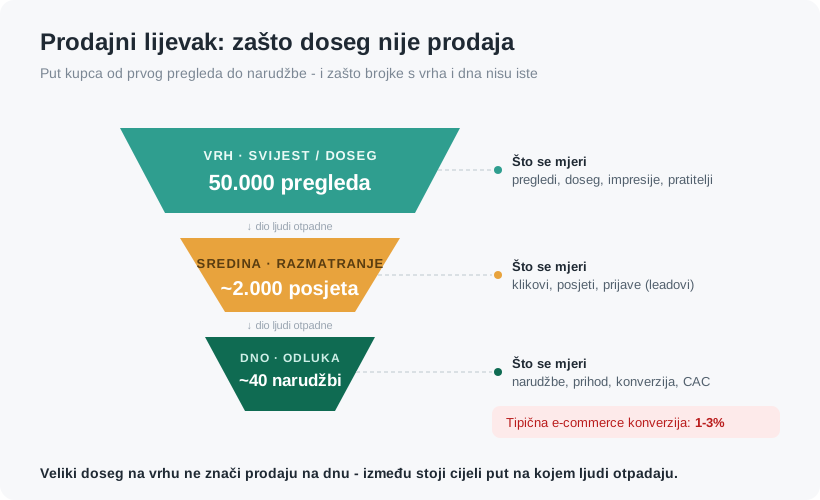 Sales funnel is a metaphor for the customer’s journey from the moment they first hear about an agency / company / professional to the moment they purchase a service or product. It’s called a funnel because it’s wide at the top and narrow at the bottom—many people enter at the top, but only a portion actually buy at the end. People “drop off” along the way, so it’s a funnel, not a pipe.
Generally, such a “funnel” has three levels:
- Top of the funnel (awareness/reach). This is where people who have just seen or heard about the company or agency are. Measured by views, reach, impressions, visits, followers. Those “50,000 views” live right here—it’s a metric of attention, not purchase.
- Middle of the funnel (consideration). Interested parties who compare, read, click, sign up for a newsletter, add a product to the cart. Measured by clicks, time on page, inquiries, sign-ups (leads).
- Bottom of the funnel (decision/action). Those who actually buy. This most important parameter is measured by orders, sales, revenue, conversion rate, and cost per acquisition.
When we know these basics, the sentence: views are at the top, orders are at the bottom—gains its full meaning. Views and orders are two different stages and are measured by structurally different numbers. Large reach doesn’t guarantee sales because between the top and bottom lies an entire path where potential customers/clients drop off. Realistically, of 50,000 views, only a smaller portion actually clicks, even fewer come to the site, and only 1-3% (typical e-commerce conversion) ultimately buy.
Your client who asks “we had 50,000 views, where are the orders?” is actually confusing a metric of service/brand/product awareness with a conversion metric – roughly like expecting everyone who passes by a storefront to immediately enter and buy.
The practical value of this way of thinking is diagnostic: if reach is high but sales aren’t coming, the problem usually isn’t at the top of the funnel (visibility), but somewhere lower down – the offer, the price, trust, the website’s design and loading speed, a complicated buying process.
That’s where the solution is sought, and certainly not in emphasizing “even more views.”
How Much Such a Client Actually Costs You
The painful fact is that the cost of the wrong client is rarely seen on the invoice. It leaks through unpaid work, through hours spent chasing payment, and through better jobs you didn’t accept because you were busy putting out fires.
If we set the planned project margin at 100 (you know the figure and define it according to your cost structure and/or averages in your industry/field of operation), this is roughly what the path to actual margin looks like.

Figure 2: Illustrative model of margin erosion on a project with a problematic client.
The second problem is disproportion. There’s an anecdotal saying that 90% of problems come from 10% of clients, but documented data tells a more precise (unfortunately not more comforting) story.
Measured by profit, the top 20% of clients usually bring in more than 80% of total profit, while the bottom 20% consume two to three times more time than the aforementioned top 20%.
In one documented agency case study (use case), smaller clients made up 25% of the base but generated 80% of all complaints, haggled prices down by up to 40%, requested three times more revisions, and paid with over 60 days’ delay.
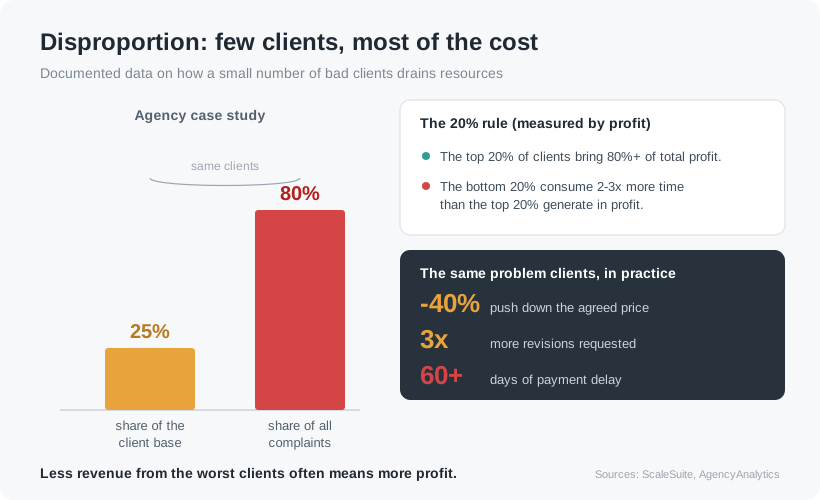
Figure 3: Documented disproportion—how a smaller number of bad clients takes up resources
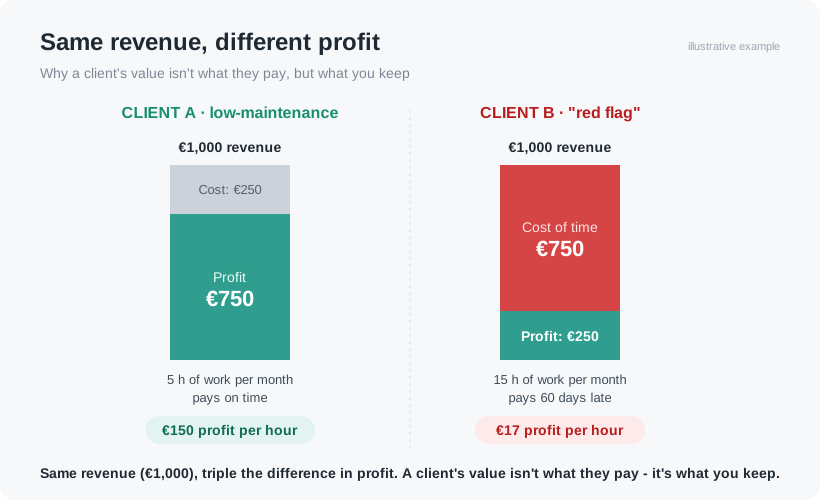
The conclusion is uncomfortable but liberating: an agency that gets rid of the worst 20% of clients and doesn’t replace them with anything is often more profitable than before, and therefore the complete truth is in the saying: “Revenue is vanity, profit is sanity” **
“Revenue is vanity, profit is sanity” is a business saying that warns of a common trap: looking at the wrong number as a measure of success.
Revenue (vanity) is the total amount that comes in from clients—a large, impressive number that’s pleasant to say (“this year we made xxx,xxx euros in turnover“). It’s called vanity because it sounds good, but by itself doesn’t tell you if anything is left at the end.
Profit (sanity) is what actually remains when you subtract all costs from revenue—salaries, tools, time, overhead. This is the number that determines whether the agency will survive and grow. It’s called sanity because it’s the real state of the business, regardless of how it looks from the outside.
Why this matters in our story about red flag clients: two clients can bring the same revenue but completely different profit.