
SEO and Literacy - Is SEO a Grammar Nazi?

Is SEO a Grammar Nazi?

In today's digital environment, the content of web pages and/or posts is a key element for attracting users and achieving business goals. However, incorrect or illiterate writing - including mistakes in spelling, grammar and style - can have serious consequences.

This time we focused on the Croatian market, where searches are mainly conducted in the Croatian language via Google.hr, and our famous SEO ( Search Engine Optimization ) plays a crucial role in visibility.

Based on available data and research, as well as expert opinions, we investigated how content irregularities affect SEO, user experience, and overall marketing results.

The results clearly show that the errors are not only of a cosmetic nature and fodder for the so-called Grammar Nazis , already in the real competitive business world , can ultimately reduce traffic by up to 70% and increase the bounce rate (abandonment rate) up to a terrifyingly high 85% .

Impact on SEO: Direct and indirect mechanism

Google’s algorithm does not directly penalize errors in spelling or grammar as a direct ranking factor , but they have a strong indirect impact through user experience (UX) and visitor behavior. Figuratively speaking, when the Google sniper “misses” you, you run into infantry that runs over you.

In order to give you a clearer idea of ​​what this is all about, take a look at the key mechanisms used primarily by Google when ranking individual content/pages:

  • Content Readability and Indexability : Errors make it difficult to understand, which can confuse Google’s bots (those are the bots we want on the page) when crawling. If the content is not clear, the algorithm may rank it lower because it considers it not “high quality”. For example, Bing (less relevant in HR, but similar principle) explicitly penalizes spelling mistakes when ranking .
  • User Behavior : A high bounce rate and low dwell time (time spent on a page) signal to Google that the content is poor, which leads to a drop in rankings. According to research by Website Planet (which tracked over 5,000 visits to different pages), pages with errors have an 85% higher bounce rate than those without spelling or grammatical errors. This directly affects SEO because Google prioritizes pages with high engagement.
  • Loss of backlinks and authority : Poor content reduces the likelihood that other websites will link to it, because it looks unprofessional. Backlinks are key to EAT ( Expertise, Authoritativeness, Trustworthiness ), which is especially important in HR where local authority plays a significant role.

For our market, where the Croatian language is specific (with diacritical marks such as č/ć, dž/đ), errors such as “kuče” instead of “kuće” or the even worse tipfeler “to kill” instead of “in essence” (a frequent occurrence on social networks, according to Reddit discussions) significantly damage credibility, or in some situations lead to a basic misunderstanding of what the text or publication is actually about.

Impact on marketing actions: Loss of trust and conversion

Illiterate content not only reduces SEO, but also overall marketing results, especially in our country where consumers prefer local, reliable brands (btw. this is also the case in other “small” countries that are geographically classified in a less developed part of Europe):

  • Loss of trust : According to global statistics, 70% of users are less likely to click on an ad or page with errors.
  • Decreased traffic and conversions : Pages with errors get fewer visits and lower rankings, leading to a loss of organic traffic. In HR, where 81% of users look for services locally , this means significantly fewer leads .
  • Impact on social networks and AI : Content is often shared on social networks, where mistakes quickly go viral (eg Reddit examples of “no-no-no” or copied articles). Google’s AI Overview (2025) further favors clean content, so errors can reduce visibility in AI results.

The impact of grammatical and spelling errors in content on results

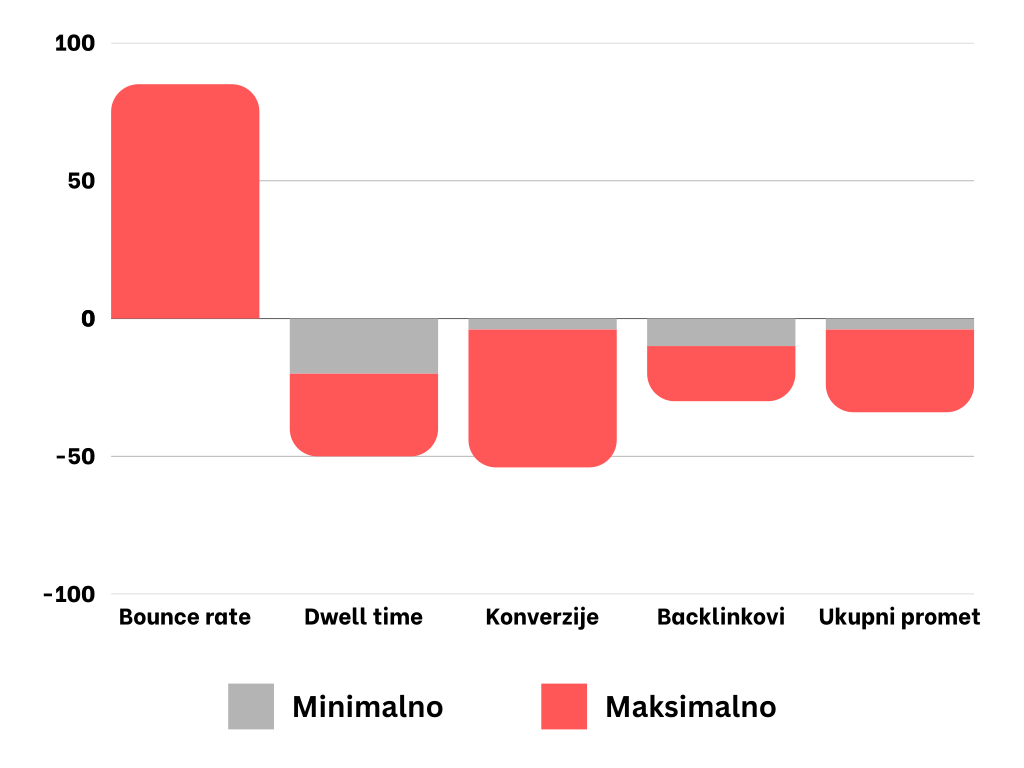
The table is consolidated based on multiple research and expert analysis, with a focus on global data (mainly from Website Planet studies and similar ones) and analogous estimates for the Croatian market (adjusted to the local context, such as Ispravi.me statistics). Estimates are not always exact numbers from a single source, but ranges based on aggregated data on the impact on SEO, UX, and conversions.
Tablica statistika za clanak seo grammar nazi - iv ci d. O. O.

Here is a detailed breakdown of the sources by column of the chart, with sources and key quotes:

  1. Bounce rate (+85% higher)

    Globally : Website Planet study (2023-2025), analyzed> 5,000 visits – bounce rate on pages with errors is 85% higher than those without errors.

    Analogously for HR : Similar tendencies in local SEO analyses, where errors (e.g. 3.14 per text according to Isprava.me 2024) increase page abandonment.

  1. Dwell time (Reduction by 20-30%)

    Globally : Website Planet – visitors stay on pages with errors 8% shorter, but aggregated data from SEO analytics (e.g. BlakSheep Creative) estimates a 20-30% drop due to reduced readability and engagement.

    For HR analogously : Local tools like Ispravi.me show that errors make understanding more difficult, which indirectly affects time spent (estimation based on similar UX studies).

  1. Conversions (-4% to -50% per visit)

    Global : Website Planet – 4% fewer visits and up to 70% fewer clicks on ads with errors; aggregated with data from SEO.com and CopyPress on loss of trust (up to 50% drop in conversions).

    For HR analog : In the HR context (e.g. e-commerce), errors like those in 29 million cases (Ispravi.me 2024) lead to a similar decline, especially in local searches where trust is key.

  2. Backlinks (Reduction in authority by 10-20%)

    Globally : CopyPress and TechAdv – errors reduce the likelihood of linking by 10-20%, because the content looks unprofessional and loses EAT (Expertise, Authoritativeness, Trustworthiness).

    For HR analogously : Local examples (e.g. Reddit discussions and SEO guides) show that irregular Croatian (č/ć errors) reduces authority by a similar percentage.

  3. Total turnover (-4% to -30%)

    Global : Website Planet – 4% fewer visits; a wider range from HawkSEM and WordStream analysis on indirect ranking impact (up to 30% loss due to poor UX).

    For HR analogous : In the HR market, where 81% of users search locally, errors (29 million in 2024, Ispravi.me) lead to a similar decline in organic traffic.


Specificities of the Croatian market

In the HR market, where Google.hr is dominant (over 95% of the market), local SEO requires grammatically correct and as good as possible Croatian. According to SEO experts (e.g. from Digital Aetas or Slade.hr), errors are common due to the influence of the Serbian/Croatian language (e.g. copied texts, as in the examples from Index.hr). Reddit discussions (r/hrvatska, r/CroIT) point out that the spelling is less strict than in Serbia, but mistakes like “nebi” instead of “ne bi” or “ubiti” instead of “u biti” quickly destroy credibility.

Statistics from Ispravi.me show that errors are on the rise: 3.14 errors per text were detected in 2024, mostly in blogs and e-commerce sites. This is especially problematic for small HR entrepreneurs, where 67.6% of clicks go to the first page of Google – errors can drop them from the top 10 results.

Recommendations for improvement

  1. Use tools : Ispravi.me (free, local) or Grammarly (with Croatian support) to check. Aim for< 1 mistake per 100 words (if you want to meet the statistics and be just better than average) or, eliminate mistakes and be a role model for others 😊
  2. Structure your content : Use short sentences, subheadings, and bullet points for better readability.
  3. Test locally : Check your content in Croatian (e.g., differences between č/ć) and use Google Search Console to track UX signals.
  4. Collaborate with experts : Hire copywriters or SEO agencies for review – the ROI from smartly composed and SEO optimized content is 5-10x higher than with paid ads.
  5. Tracking results : Use Google Analytics to measure bounce rate before/after correction.

After all of the above, and with the known research results, we can conclude: improperly written content can reduce SEO rankings by 10-30% indirectly , through poor UX and loss of trust, which ultimately reduces marketing results by 20-50% (less conversions, traffic). In the Croatian market, where the local language is key to organic traffic, this is especially critical – mistakes like those discovered in 29 million cases in 2024 can cost business opportunities. Investing in quality content is not an expense, but a necessity for long-term success.

Share this article (if you like it of course)

Related articles

Seo and literacy - is seo a grammar nazi?

Is SEO a Grammar Nazi?

This time we focused on the Croatian market, where searches are mainly conducted in the Croatian language via Google.hr, and...
0 Comments
Page builder

Creating good websites: the use of the so-called page builder – advantages, disadvantages and development

Basically, it's clear to you that we're not going to talk about food this time either, but about ready-made solutions,...
0 Comments
Privacy Overview

This website uses cookies so that we can provide you with the best user experience possible. Cookie information is stored in your browser and performs functions such as recognising you when you return to our website and helping our team to understand which sections of the website you find most interesting and useful.